
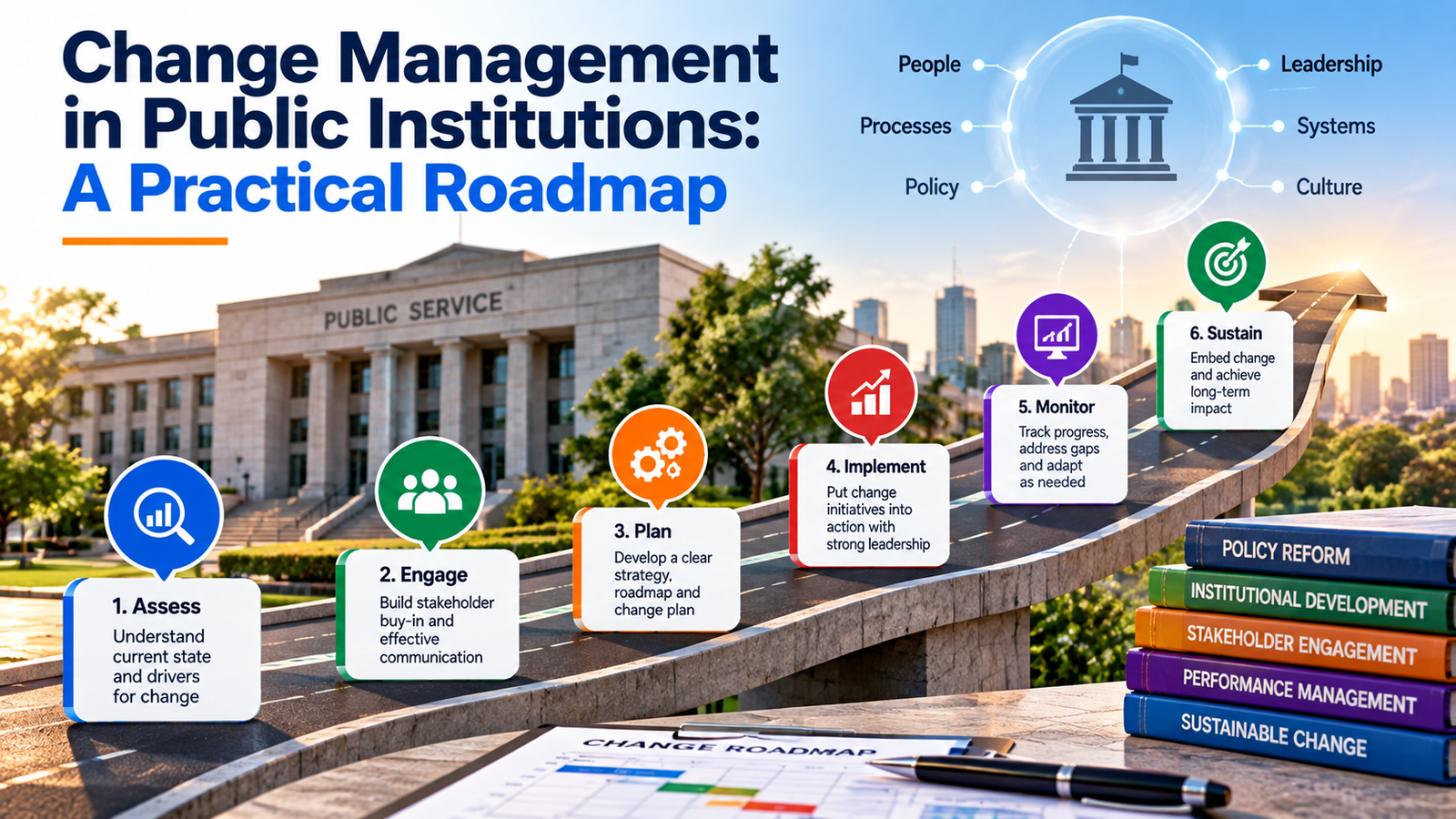
Change Management in Public Institutions: A Practical Roadmap
Public Sector Change Management is increasingly important for organisations seeking stronger operational performance and accountable decision-making. For government transformation teams, the challenge is often resistance to new procedures. A practical approach connects policy, staff responsibilities, usable evidence and regular management review rather than relying on documents alone.
What is public sector change management?
In practical terms, public sector change management involves a deliberate set of decisions, procedures and review activities that help teams achieve defined objectives. The precise approach should reflect organisational size, operating environment, applicable requirements and the people affected by decisions. For NGOs, government institutions and private-sector organisations, an effective system should be proportionate, documented and regularly improved.
Why organisations need a structured approach
Without clear responsibilities and reliable information, teams may repeat avoidable errors, miss emerging problems or struggle to demonstrate value to funders, leaders and stakeholders. Structured management helps translate strategy into everyday action, clarify accountability and establish an evidence trail for decisions.
Three essential components
1. Stakeholder engagement
Begin by mapping the current process and gathering evidence from staff, relevant documents and stakeholders. Identify where practice differs from policy and where limited capacity affects delivery. Record assumptions and avoid treating a single interview or report as conclusive evidence.
2. Change readiness
Agree the intended result, decision criteria and responsible roles. Select a manageable set of actions that address the most significant gaps. Consider cost, staff workload, legal obligations and any contractual or donor conditions before implementation.
3. Implementation communication
Establish a review rhythm, track exceptions and share findings with decision-makers. Use feedback to adjust procedures, provide targeted support and document what has changed. Improvement depends on whether teams use information, not simply whether reports are produced.
Practical implementation table
The following is an illustrative planning template, not a description of a specific organisation.
| Focus area | Practical action | Suggested owner |
|---|---|---|
| Stakeholder engagement | Assess stakeholder concerns | Responsible technical lead |
| Change readiness | Plan phased adoption | Programme or departmental manager |
| Implementation communication | Monitor uptake and service quality | Quality or oversight focal point |
A five-step implementation roadmap
- Diagnose: collect baseline information and clarify the organisational problem.
- Prioritise: distinguish urgent control gaps from longer-term capability needs.
- Design: define actions, accountable owners, milestones and resources.
- Implement: pilot the approach, communicate responsibilities and support teams.
- Review: compare progress with the baseline, investigate gaps and revise the plan.
Example performance dashboard
Illustrative targets only; these are not survey results or verified sector statistics.
| Measure | Illustrative target | Review frequency |
|---|---|---|
| Actions completed by agreed deadline | 90% | Monthly |
| Records passing quality checks | 95% | Quarterly |
| Priority issues assigned an owner | 100% | Monthly |
Targets should be adapted to organisational capacity and the consequences of failure. A high completion percentage does not necessarily prove that services or outcomes have improved; combine activity measures with quality and outcome evidence.
Common implementation mistakes
- Adopting templates without adapting them to actual operations.
- Assigning responsibility without sufficient authority or resources.
- Collecting indicators that nobody uses for decisions.
- Overlooking staff, partner or community feedback.
- Confusing completed activities with meaningful outcomes.
How training can support better results
Professional development is most valuable when participants work through real decisions, practise tools and receive feedback. Alverton Global Consultancy provides corporate training and capacity-building programmes that connect practical skills with organisational priorities. Teams can use the roadmap and tables in this guide as a starting point for internal discussion, while tailoring implementation to their own policies and requirements.
Frequently asked questions
Who should lead public sector change management initiatives?
Leadership should sit with a role that has sufficient authority to coordinate the relevant teams, supported by technical specialists and operational owners.
How long does implementation take?
It depends on the size of the organisation, the complexity of its processes and the resources available. A focused pilot can establish learning before wider rollout.
How can progress be measured?
Define a baseline, a small number of relevant indicators, data sources, review frequency and responsibility for corrective action.
Can these methods be used in NGOs and public institutions?
Yes, but procedures must reflect the applicable governance, legal, procurement, donor and stakeholder requirements in each setting.
Related professional training
To develop these competencies further, explore the Leading Change and Innovation in Public Institutions course offered by Alverton Global Consultancy. The programme provides a structured route to strengthening relevant workplace knowledge and practical skills.
Next steps
Start with a short diagnostic meeting, choose one priority improvement area and assign an owner to develop a documented action plan. Review evidence regularly and scale up only after the approach has demonstrated practical value.

You may also like
How to Build a Logical Framework for NGO and Donor-Funded Projects
Public Financial Management Reform: Priorities for Local Governments